
You Focus on Running Your Business, We Help You Keep Your Website In Compliance

Is Your Website Legally Compliant?

If You Think There's a Possibility Your Website Is Not In Compliance With Worldwide Cookie and Privacy Laws... It Probably Isn't!

Enterprise-grade consent management that helps you achieve GDPR, CCPA & global compliance while enhancing your user experience.

We Integrate With Every Major Website and Shopping Cart Platform

There's Just Too Many To List All, Here a Just a Few We Can Integrate With

WordPress

WordPress

Clickfunnels

Webflow

Weebly

Shopify

Wix

Kajabi

Magento

Leadpages

Simvoly

Keap

This Isn't About Using Scare Tactics, This Is About Real World Legal Issues

Our System Will Monitor Your Site, And Update it Regularly, Ensuring All Cookie and Privacy Laws Are In Place and Protecting You!

The Hidden Legal Risk Your Website Faces Every Day
Are you aware that your website could be facing potential fines of up to $42,530 per violation under the California Consumer Privacy Act (CCPA)? Or that the General Data Protection Regulation (GDPR) can impose penalties of up to $22 million or 4% of your global annual revenue – whichever is higher? These aren’t hypothetical scenarios. They’re the harsh reality facing businesses that fail to properly implement cookie consent management on their websites.
Why Cookie Compliance Matters Now More Than Ever

The digital landscape has transformed dramatically. What was once a simple matter of web design has evolved into a complex legal obligation with severe consequences for non-compliance. Every day, your website collects valuable data through cookies – small text files that track user behavior, preferences, and personal information.

But here’s what most business owners don’t realize: collecting this data without proper consent is now illegal in numerous jurisdictions worldwide.

Please...Don't Make This Costly Mistake. This Applies To Everyone.

"But I Don't Think It Applies To Me, My Company Is Not In Any Of Those Countries" That's Where You're Wrong... It's Called, "Extraterritorial Reach"

No, your company does not need to be located in the country to receive GDPR or CCPA violations. Both regulations have extraterritorial scope, meaning they apply based on whose data you process, not where your business is physically located.

For GDPR: The GDPR applies to any company that collects or processes personal data of EU residents, regardless of the company’s location. This is why companies across the world, including many US-based organizations, have been fined under GDPR even though they have no physical presence in the EU.

For CCPA: The CCPA applies to businesses that collect personal information from California residents, even if the business is located outside California or even outside the United States. What matters is that you’re offering services or products to California residents and meet the other CCPA criteria regarding revenue or data volume.

This extraterritorial reach is one of the most significant aspects of modern data privacy laws. For example, a company based in Asia with no offices in Europe or the US could still be subject to both GDPR and CCPA if it:

  1. Collects or processes data from EU residents (triggering GDPR)
  2. Collects or processes data from California residents and meets the CCPA thresholds (triggering CCPA)

That’s why global companies often implement compliance programs that address both regulations, even if they don’t have a physical presence in those jurisdictions.

Follow The Law

A Few Questions You May Have About The Service and Offer

Can't I Just Use a WordPress Plugin For Consent?

The answer is of course you can except. You won’t have the advantages dedicated cookie consent platform service typically offers:

  • More comprehensive compliance with global privacy regulations like GDPR, CCPA, and ePrivacy
  • Directive across multiple regions
  • Advanced consent management with granular cookie categorization and user preference controls
  • Centralized management across multiple websites or platforms beyond just WordPress
  • Regular automatic updates to keep pace with changing regulations and requirements
  • Detailed analytics and reporting on consent rates and user interactions
  • More robust documentation and legal templates that are professionally maintained
Do I need a webmaster to use the service as customer of agency?

No you don’t. We will connect with you do find out exactly what you want your Cookie Consent Banner to look like. That includes position, and color of the banner. Then we set up it so it looks the way you want it. We will generate a code that you can place in the header of your website, or we can even take care of that for you so you can focus on other things.

After that our software will work tirelessly to protect your business, and keep your customers happy.

What about updates and law changes?

Great question. As laws evolve and requirements change regarding cookie consent requirements, we’ll be updating our product to stay current no matter where your website visitors are coming from.

This is one of the main reasons website owners use our service. If you use a cheap WordPress plugin there’s no way the creator of that plugin is continually updating the consent policies! So you might be saving a few dollars, but it won’t protect you.
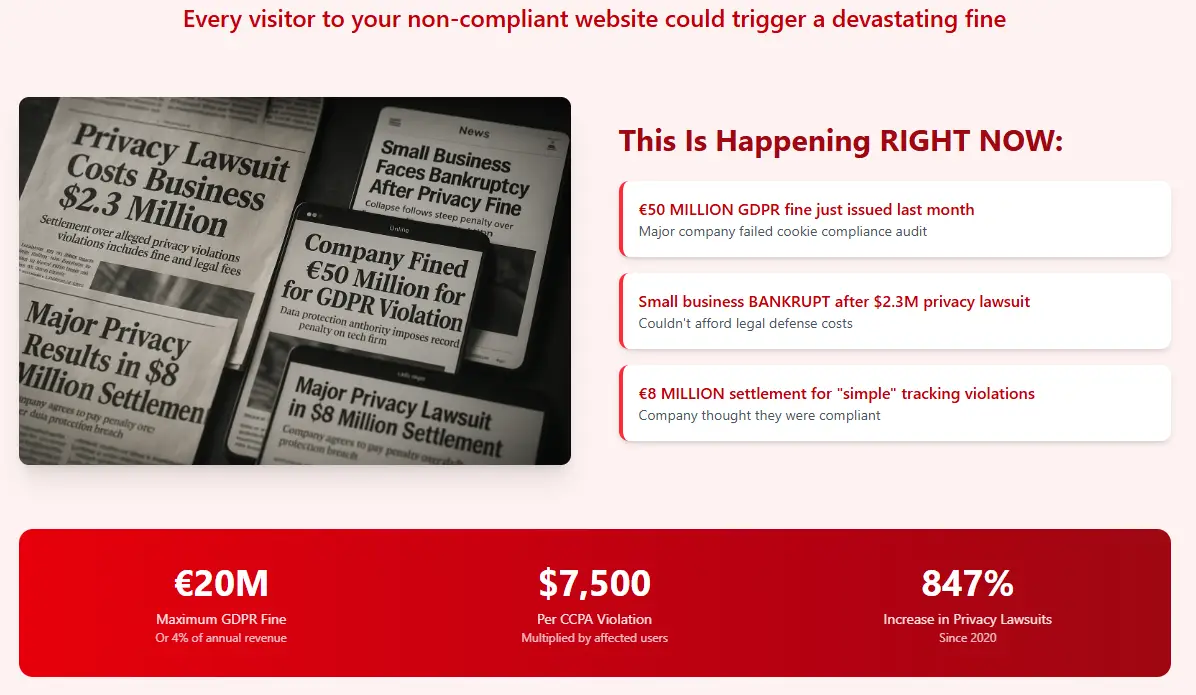

Real-World Consequences: When Cookie Compliance Goes Wrong

Consider the case of Sephora, the multinational beauty retailer. In August 2022, Sephora agreed to pay a $1.2 million settlement for CCPA violations related to their cookie practices. The company failed to properly disclose to consumers that they were selling their personal information and didn’t process opt-out requests.

Or take British Airways, which faced a staggering $22 million GDPR fine partly due to inadequate cookie consent mechanisms that led to a data breach affecting over 400,000 customers.

These aren’t isolated incidents. They represent a growing trend of regulatory authorities cracking down on non-compliant websites.


You May Know About California's CCPA Policy, But Do You Know Other States Have Laws Too and More Are Coming

CCPA (California Consumer Privacy Act) and CPRA

Other United States Laws

Virginia Consumer Data Protection Act (CDPA)
  • Effective January 1, 2023
  • Requires opt-in consent for sensitive data processing
  • Provides rights to access, correct, delete, and opt-out of targeted advertising
Colorado Privacy Act (CPA)
  • Effective July 1, 2023
  • Requires opt-in consent for sensitive data
  • Right to opt-out of targeted advertising, profiling, and sales
Connecticut Data Privacy Act (CTDPA)
  • Effective July 1, 2023
  • Similar to Colorado’s law with opt-in for sensitive data
  • Creates right to opt out via universal opt-out mechanisms
Utah Consumer Privacy Act (UCPA)
  • Effective December 31, 2023
  • Less stringent than other state laws
  • No opt-in requirements for sensitive data, just right to opt out
Florida Digital Bill of Rights
  • Effective July 1, 2024
  • Applies to businesses with >$1B global revenue or data on 1M+ consumers
  • Focused on targeted advertising opt-out International Laws
GDPR (General Data Protection Regulation)

Other International Laws

Brazil: Lei Geral de Proteção de Dados (LGPD)

  • Similar structure to GDPR
  • Requires clear, unambiguous consent
  • Administrative sanctions up to 2% of revenue in Brazil (cap of R$50 million per violation)

Canada: PIPEDA and CPPA

  • PIPEDA currently in force; CPPA is its proposed replacement
  • Knowledge and consent required for collection, use, or disclosure of personal information
  • Meaningful consent standard emphasized

Thailand: Personal Data Protection Act (PDPA)

  • Effective June 2022
  • Explicit consent required for collection of personal data
  • Penalties up to THB 5 million

Japan: Act on the Protection of Personal Information (APPI)

  • Updated significantly in 2020
  • Requires consent for data transfers to third parties
  • Special care for sensitive data (“special care-required personal information”)

South Korea: Personal Information Protection Act (PIPA)

  • One of the strictest privacy regimes globally
  • Requires explicit consent for collection and use of personal information
  • Separate consent required for different purposes

Australia: Privacy Act 1988 (with amendments)

  • Contains Australian Privacy Principles (APPs)
  • Consent should be informed, voluntary, current, and specific
  • Penalties up to AUD 50 million or percentage of turnover

Singapore: Personal Data Protection Act (PDPA)

  • Consent obligation is cornerstone
  • Deemed consent provisions
  • Financial penalties up to 10% of annual turnover or SGD 1 million

Simplifying Compliance for the Modern Web

Everything you need for complete compliance

Our platform provides an all-in-one solution for managing consent, enhancing privacy, and maintaining compliance across all your digital properties.

Global Compliance

Automatically comply with GDPR, CCPA, ePrivacy and other global privacy regulations with our constantly updated solution.

Beautiful Design

Fully customizable consent notices that match your brand’s look and feel, with elegant animations and responsive layouts.

Multi-language Support
Auto-detect visitor language and display consent notices in multiple languages with our built-in localization system.
Performance Optimized
Lightweight implementation with minimal impact on your website’s loading speed and performance metrics.
Easy To Implement
Simply copy our easy to use snippet and go to your website and paste it in your header and that’s it. In a few seconds you are ready to go.
Intuitive Dashboard
Manage all your websites from one central dashboard with real-time analytics and compliance reporting.